
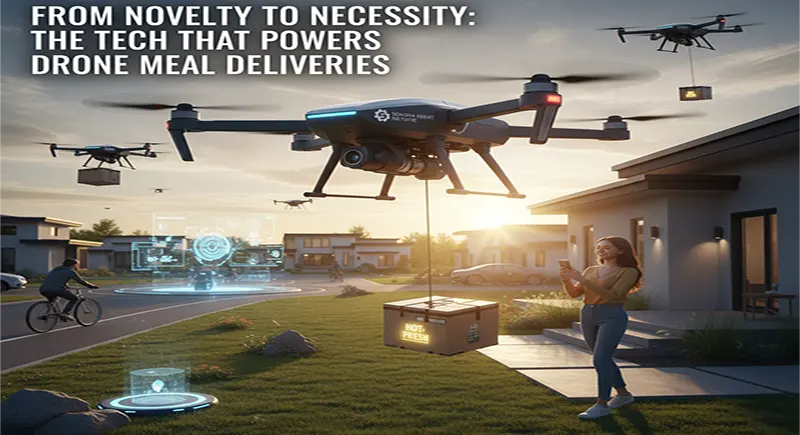
What began as a futuristic concept is rapidly becoming a practical solution for modern logistics. Drone-based food delivery is no longer just a marketing stunt or tech demo. It is emerging as a real service model powered by steady advancements in aerial hardware, intelligent flight control and machine-assisted decision-making. Sonoran Desert Institute (SDI), accredited by the Distance Education Accrediting Commission (DEAC), offers foundational online coursework in uncrewed aerial systems, preparing students for FAA Part 107 certification and safe, compliant drone operation. As the complexity of drone applications expands, SDI’s approach underscores the need for responsible, credentialed professionals.
At the heart of every successful drone meal delivery is a finely tuned system of integrated components. From navigation sensors to onboard processors, today’s drones are built to fly with precision, avoid obstacles and keep food safe throughout the journey. As this service develops from novelty to necessity, it is the sophistication of the technology that can ensure its safety, reliability and scalability.
Flight Hardware
The foundation of any delivery drone is its flight system. These multi-rotor UAVs are built for Vertical Takeoff and Landing (VTOL), making them well-suited to residential neighborhoods, rooftops and confined delivery zones. Most food delivery drones are designed with four to eight rotors for stability and redundancy in case of mechanical failure.
Frames are lightweight but durable, often constructed from carbon fiber or reinforced polymers to withstand the rigors of repeated flight. Battery systems are optimized for a balance between power and weight, allowing drones to travel several miles on a single charge, while still carrying payloads of up to five pounds.
GPS and GNSS
Drones rely on satellite-based systems such as the Global Positioning System (GPS) and the Global Navigation Satellite System (GNSS) for precise geolocation. These technologies allow the drone to maintain accurate flight paths, hover in place and land in designated zones, with minimal deviation.
Modern drones can pinpoint delivery targets within a few feet, thanks to Real-Time Kinematic (RTK) positioning and differential GPS corrections. This level of accuracy is essential for urban delivery, where tight spaces, driveways, balconies or marked landing pads are required.
If a drone can’t find its mark or drifts, of course, the risk of failed delivery or public safety issues increases. That’s why operators trained in advanced positioning systems are key to maintaining reliability.
Obstacle Avoidance and Object Detection
To fly safely in populated areas, drones must sense and avoid both static and dynamic obstacles. A network of onboard sensors, including ultrasonic rangefinders, lidar, radar and stereo-vision cameras, makes this possible.
These sensors map the surrounding environment in real-time and feed data to the drone’s onboard processor. The system then uses this information to make decisions in mid-flight, avoiding buildings, trees, power lines or even birds.
Smarter Flight Decisions
Artificial intelligence is transforming how drones interpret data and make decisions in real-time. Machine learning algorithms are used to optimize routing, detect landing zones, manage battery consumption and identify potential hazards. In the context of food delivery, AI is also used to predict order times, synchronize drone dispatch with restaurant workflows and prioritize deliveries based on distance and traffic conditions. Some drones even adapt flight behavior based on environmental conditions or customer preferences, like quiet landing modes or custom drop-off points.
AI doesn’t replace the pilot but enhances the pilot’s oversight by automating routine tasks and managing the drone’s responses to common flight scenarios. Still, trained operators are needed to monitor AI decisions and intervene if systems fail or conditions change rapidly. Sonoran Desert Institute recognizes that as drones grow more autonomous, the need for skilled human oversight does not disappear. It becomes more nuanced, requiring a deeper understanding of system logic and protocol.
Keeping Food Safe and Secure
Delivering food isn’t just about getting from point A to B. It’s about delivering hot meals, intact packaging and a positive customer experience. That’s where payload systems come in. Delivery drones are equipped with specialized compartments or payload bays designed to insulate food, maintain proper temperature and secure containers during flight. Some drones use locking mechanisms that release only upon reaching a verified delivery zone.
Others use tethered systems to lower meals safely to the ground, without the drone itself landing. This method prevents ground interference, reduces noise near homes and allows delivery to hard-to-reach spots like balconies or fenced yards. These systems are designed not only for functionality but for public comfort. Their quiet descent and precision minimize disruption and help ease consumer concerns about safety and noise.
Staying Connected
Drone meal delivery depends on reliable, continuous communication between the UAV, the operator and supporting infrastructure. It is managed through a combination of radio links, cellular networks and sometimes satellite connectivity in remote areas. These systems ensure that drones can receive updated instructions, stream telemetry back to a control station, and share real-time location with both operators and customers. Some models integrate directly with restaurant software and customer apps, providing live tracking and ETAs similar to rideshare platforms.
Redundant communication systems are critical for meeting FAA requirements and avoiding mid-air loss of control. If a connection fails, drones must be able to return autonomously or land safely, and operators need training to manage signal disruptions and apply backup procedures, when necessary.
The Human Element Behind the Tech
As powerful as technology is, it doesn’t operate itself. Certified drone operators are responsible for mission planning, compliance, preflight inspections, post-flight diagnostics and customer satisfaction.
They ensure that every piece of tech, from rotors to AI, is functioning properly, and within safety standards.
Remote training programs, like those offered by SDI, focus on core drone operation principles, including FAA regulations, safety protocols and flight planning. While students do not train on advanced hardware systems specific to autonomous food delivery, the foundational skills can support further specialization in UAV logistics and systems integration.
From Pilot Program to Everyday Service
The leap from novelty to necessity is already in motion. Drone meal delivery is no longer limited to early trials or niche markets. It is expanding steadily across suburban neighborhoods, college campuses and rural communities. As technology becomes more reliable and efficient, adoption can likely accelerate. The long-term success of this model depends not only on the aircraft itself but also on the systems and people behind each flight. Advanced navigation, smart logistics and trained professionals all play a vital role in ensuring safe, smooth and timely service.
For drone delivery to reach mainstream adoption, ongoing investment in public education, infrastructure, and regulatory alignment is essential. Earning community trust, proving safety and consistently delivering positive experiences will influence how quickly and widely the service is embraced. The potential is massive, but transforming it into everyday convenience will demand careful planning, alongside technical innovation.

